Situationships
How to Get Over Someone You Never Dated
Why losing an almost hurts like losing the real thing, why the fantasy is stronger than any ex, and the first step that actually helps.
You’ve done the math and it doesn’t add up.
A few months of texting. Some almosts. One night that felt like the start of something. That’s all it ever was, on paper. So why does losing it hurt like losing something real?
And you can’t even tell anyone properly. There’s no word for what you lost. “We were talking” sounds like nothing. “We never got the chance” sounds dramatic. So when it ended, however it ended, a slow fade, a someone-else, or just silence, you grieved it in private, half embarrassed at how much it hurt.
Don’t be. Getting over someone you never dated runs on its own rules, and some of them are crueler than the ones a real breakup follows. What is actually happening is this.
The fantasy never got a chance to die
Here’s the unfair advantage a real ex has over your almost: a track record.
When you date someone for two years, your memory holds the whole thing. The good-morning texts, and also the fight in the car. The way they looked at you, and also the way they didn’t, near the end. When it’s over, your mind has evidence on both sides, and the bad evidence helps you leave.
An almost gives your memory nothing but the good parts. There was no boring Tuesday. No annoying habit. No argument about dishes. Memory already tilts toward the good and quietly edits out the rest, a bias researchers call rosy retrospection (Adler et al., 2020), and to be honest about the science, it isn’t universal (Peetz, 2022). But with an almost, there’s nothing on the other side of the scale at all. The relationship you’re mourning is the version your mind finished writing by itself. Perfect, because it never had to survive being real.
You’re not missing a person. You’re missing a version of them that reality never got to test.
The not-knowing was the fuel
Think back. You never actually knew where you stood. You read their messages twice before answering. You noticed which stories they watched. You held every plan loosely, in case they finally suggested one.
Most people assume the mixed signals were the obstacle. That you fell for them despite never being sure. It was closer to the opposite.
In one study, people were more attracted to someone when they were left uncertain whether that person liked them (Whitchurch, Wilson and Gilbert, 2011). The not-knowing keeps the mind circling back, and all that thinking feels like feeling. One honest caveat: this mostly works when there’s some real sign of interest, and clear disinterest kills it (Montoya, 2015; Birnbaum, 2018). Which describes an almost exactly. Enough warmth to hope. Never enough to know.
Not knowing where you stood made you want them more. The maybe was the engine.
The chase was a pattern with a name
You reached, they stepped back. They went quiet, you leaned in. The one time you pulled away, they suddenly appeared again, warm as ever, and the whole thing restarted.
Researchers see this two-person dance so often it has a name: one person pursues closeness while the other backs away the moment it gets real (Mikulincer et al., 2010; Locke, 2008). The more you chased, the more they ran. And the running looked like mystery, so you chased harder.
That dance isn’t proof of a special connection. It’s a pattern two people fall into, and it would have run the same way with almost anyone sitting in your seat. Knowing that doesn’t erase the feelings. It just takes the “we had something rare” story, which is part of what keeps you stuck, down to its true size.
The chase felt like connection. It was a pattern, and the pattern was never going to end with you being chosen.
You’re holding on for what you already spent
Eight months of being available. All those carefully written replies. The plans you kept clear just in case. Walking away now would turn all of it into wasted time, so you hold on a little longer, which spends a little more.
That math has a name too: the sunk-cost effect. We keep investing in things because of what we’ve already put in, even when what we’ve put in is exactly why we should stop (Rêgo et al., 2018). It is the schedule casinos are built on, and an almost-relationship runs on exactly the same one.
Here’s the plain truth about sunk costs: the time is already gone. Holding on to it will not redeem the time you spent, and letting go will not waste it either. The time was already spent, and what you felt during it was real. The only thing still being decided is the next month of your life.
You’re not holding on because it’s still worth it. You’re holding on because of what it already cost.
Being un-chosen is not a verdict
Underneath everything, the wound that actually stings: they saw you, and they didn’t pick you.
Your sense of your own worth works like a gauge, and the gauge measures one thing: do people want me? Psychologists call it the sociometer (Leary, 1999; 2005). When someone you wanted doesn’t choose you, the needle slams down, and it feels exactly like discovering the truth about yourself.
It isn’t the truth. It’s one reading, from one instrument, thrown off by one person who could not or would not choose anyone properly, you included. A person who gives crumbs isn’t an authority on your worth. They’re evidence about their own capacity, and nothing else.
One person’s no is a faulty reading, not the truth about you.
The first step that actually helps
Post one on this site covers cutting contact, and it applies here too. But for an almost, there’s a step that has to come first, because it’s the one nobody gives you permission to take.
Let it count.
You’ve been trying to skip the grief because you felt you hadn’t earned it. No title, no anniversary, no breakup, so no right to fall apart. That’s backwards. The grief is already here. The only choice you have is whether it gets to move through you or whether you keep it stuck by arguing with it.
Two small moves start it:
Say what it was, out loud, in plain words. “I fell for someone who kept me as an option, and it ended, and it hurts.” Not to anyone, just to yourself. Putting a feeling into plain words measurably turns down the brain’s alarm response (Lieberman et al., 2007). Naming beats numbing, and you’ve been numbing.
Name what you actually lost. Not the person who showed up, they gave you crumbs and confusion. What you lost is the future you wrote: the version of them you built, the relationship it almost became. That’s a real loss and it deserves real grief. But grieving the right thing matters, because the imagined future shrinks when you name it as imagined. The person you actually got barely holds up next to it.
Expect this to feel strange, like giving yourself permission nobody handed you. That’s exactly what it is. Grief for an almost is real grief. It just needs you to sign your own permission slip.
What you lost was real, whatever it was or was not called. Let it count, and it can finally start to end.
Where this goes next
Everything above is the why. Why the fantasy outgrew the person, why the maybe hooked you, why the chase ran the way it did, and why their no says nothing about your worth.
Understanding the mechanism takes some of its power away. But understanding a thing and getting out from under it are two different jobs, and the second one takes steps.
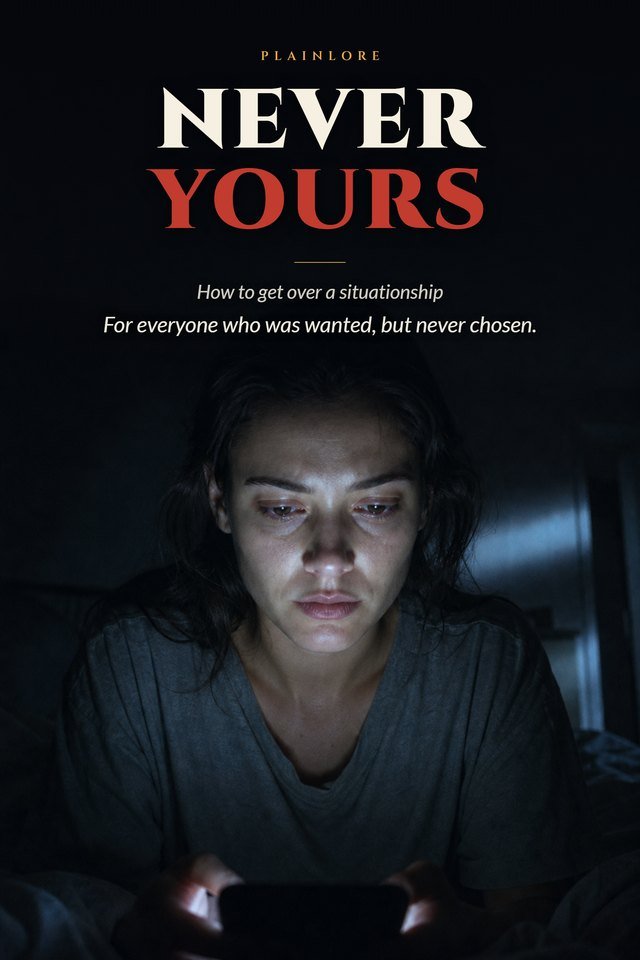
That’s what I wrote Never Yours for.
It’s the full version of everything here. The guide is the whole map and the way out, every part built on real research that’s listed at the back so you can check it yourself, including the places where the science is still messy and I say so out loud. It walks the whole way out in seven steps, from letting it count to cutting the contact to rebuilding the version of you that got smaller waiting to be picked. Then there’s a printable workbook to actually do it with, because reading changes how you see things and only doing changes how you feel.
It’s for the person who was wanted, but never chosen. No clever texts to win them back. It promises no timeline, and it never asks you to perform being fine.