Situationships
How to Get Over a Situationship
Why it hurts more than a real breakup, what the hot-and-cold actually did to you, and the one step that starts the healing.
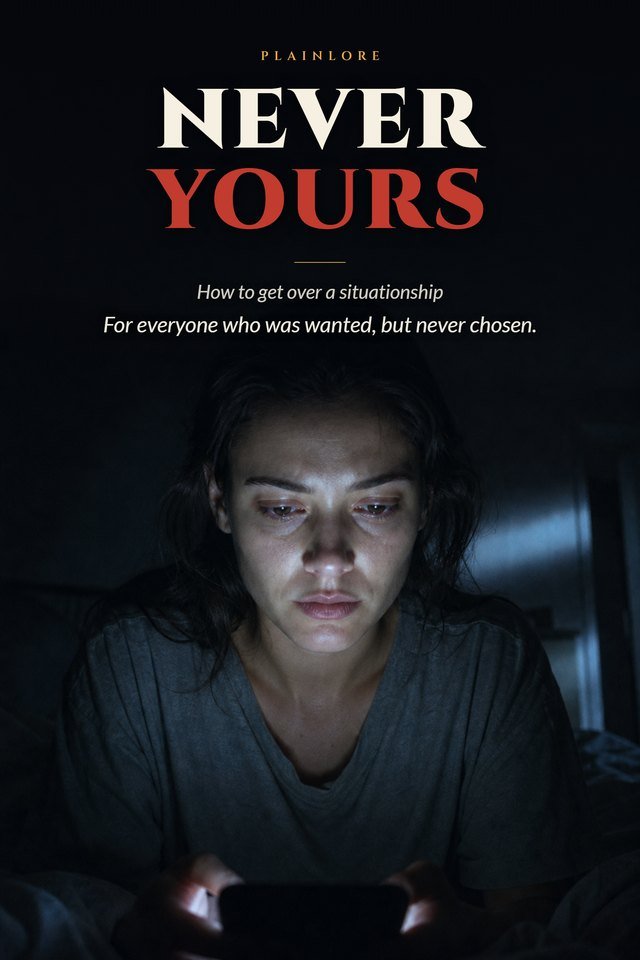
It’s 2 a.m. and you’re doing the thing again.
At midnight you promised yourself you were done. Phone face-down on the nightstand. You felt a little proud, even. Then a few minutes ago your hand reached over on its own, and now you’re deep in their profile, thumb moving slow, reading a caption you’ve already read four times.
What makes it worse is that you don’t feel allowed to be this upset. You told a friend last week how bad it was, and they tilted their head and said it: “But you guys weren’t even together.”
You nodded. Because technically, they had a point. No title. No anniversary. No breakup, really, because you can’t break something that was never officially built.
So you’ve been carrying this in private, half-convinced there’s something wrong with you for feeling this much about someone who was never yours.
There isn’t. What you’re feeling is real, it has a name, and it runs on rules nobody ever taught you. Here are the ones that matter most.
Why a situationship hurts more than a real breakup
A normal breakup is brutal, but at least it has edges. A start, an ending, a conversation, a reason. You get to say “we broke up,” and people bring you food and give you space.
A situationship gives you none of that. Researchers have a name for a loss with no clear start and no clear ending. They call it ambiguous loss, and ambiguous just means unclear. It turns out to be the hardest kind of loss to finish, because there’s nothing there to close (Boss, 2014; Zaksh et al., 2018). Your mind can’t file it away, so it leaves the folder open on the desk. Forever.
Then there’s the other problem, which is everyone else. When the people around you don’t count your loss as a real loss, that has a name too: disenfranchised grief. Grief that nobody gives you permission to have. Studies find it’s harder to recover from, because you end up carrying it alone and in secret (Doka, 2020; Cesur-Soysal et al., 2022).
So you’re dealing with two wounds. The loss itself, and then having to act like it wasn’t one.
You are not overreacting. You are grieving something the world won’t let you call grief.
The hot-and-cold was the hook
Here’s the part almost nobody tells you, and it’s usually the one that cracks people open.
You couldn’t let go because they gave you the exact thing that builds the strongest pull a human brain can form. Something good, arriving sometimes, at random.
Think about how that works. If someone texts you back warmly every single time, it’s lovely, you relax, and you stop thinking about your phone. If they never text back at all, you give up and walk away. But if they text back brilliantly on Thursday, go quiet for four days, then send something at 11 p.m. that lights you up, you will check that phone a hundred times a day. For months.
This is old and very well established in the research on how learning works (Amsel, 1967). It’s the same thing that makes a slot machine so hard to walk away from. You keep pulling the lever because the win could be the next one.
That wasn’t a relationship finding its rhythm. It was the strongest hook there is, running on you, for months.
And it would have worked on anyone. That’s not me being kind to you. That’s what the research actually says.
The randomness was the hook. That schedule would have worked on anybody, which is why being caught by it says nothing about how strong you are.
Why it feels like withdrawal
When someone you wanted pulls away, the parts of your brain that fire up are the ones that handle craving and reward. The same wiring that’s involved in addiction (Fisher et al., 2010; Watt et al., 2021).
And the ache isn’t just a figure of speech. Being rejected shows up in some of the same brain areas as physical pain. In one study, people looked at photos of their own exes while their brains were scanned, and the researchers watched it happen (Eisenberger et al., 2004; Kross et al., 2011).
So when you say “I miss them like a drug,” and when you say “it actually hurts,” you’re being literal both times.
That’s worth sitting with for a second. A craving is a thing that fades once you stop feeding it. Being broken as a person would not be.
Missing them like a drug is chemistry. Chemistry quiets down once you stop feeding it.
The closure you’re waiting for isn’t coming
You have a question. Everyone in this has exactly one. Did they ever mean any of it? Was I ever a real option? What was I to you?
You’ve been waiting for them to answer it, because it feels like their answer is the thing that will finally let you put this down.
Two hard things about that.
Not knowing is its own injury. When researchers give people bad news and leave them unsure about it, the bad feeling lasts longer than it does for the people who got a clear answer, even a harsh one (Bar-Anan, Wilson and Gilbert, 2009; Morriss et al., 2023). A flat no heals faster than a hopeful maybe. That’s exactly why getting over a situationship without closure is so much harder than getting over someone who actually ended things properly.
And the silence gets filled in by you. When there’s no information, your mind writes the missing parts, and it writes them beautifully. Some of what you’re aching for is a version of them you partly made up yourself, and a future that only ever happened in your head.
Which is also why their answer wouldn’t fix it. Even if they sat down tomorrow and explained the whole thing, you’d take that explanation apart for weeks looking for the real one underneath.
The closure you’re waiting on from them isn’t coming. The only kind that ever shows up is the kind you give yourself.
The one step that actually starts it
Fair warning. This is the hardest one, and it’s also the one that does the most.
You have to stop the contact. All of it.
Not to punish them. And not as a tactic to make them notice you’re gone and come running back, because that’s the same fantasy wearing different clothes. You do it for the same reason someone quitting drinking pours out whatever’s in the house. The craving only calms down when it stops getting topped up.
And contact means more than texting. It means:
- Watching their stories
- Looking at their profile, even the quick daily check
- Keeping the chat open so you can reread it
- Their friends’ accounts, where you go to catch a glimpse of them
- The songs you listened to together
The checking is the sneaky one, because it feels harmless while you’re doing it. It isn’t. People who keep following an ex online recover more slowly, and the more anxious you already are, the more each look costs you (Marshall, 2012; 2025; Spottswood et al., 2020).
Every check reopens the wound and puts you back near where you started. Thirty seconds of looking can cost you days.
So mute them, unfollow, block, archive the chat. Whichever one you’ll actually stick to. Then expect it to feel terrible for a while, because that’s what withdrawal does. Feeling terrible is a sign it’s working, not a sign you’re doing it wrong.
One thing to hold onto while you do it. People are consistently and badly wrong about how long heartbreak lasts. We always guess longer than it turns out to be, because we forget how quietly our own minds repair themselves in the background (Eastwick et al., 2008; Gilbert et al., 1998).
When the pain swears “forever,” that’s the exact moment it’s lying.
Where this goes next
Everything above is the why. Why it grips you, why the hot-and-cold worked, why the not-knowing keeps the wound open, and why the checking has to stop.
Seeing the machinery takes some of its power away, and it really does help. But understanding a thing and getting out from under it are two different jobs, and the second one takes steps.
That’s what I wrote Never Yours for.
It’s the full version of everything here. The guide is the whole map and the way out, every part built on real research that’s listed at the back so you can check it yourself, including the places where the science is still messy and I say so out loud. It walks the whole way out in seven steps, and stopping the contact is only the first one. Then there’s a printable workbook to actually do it with, because reading changes how you see things and only doing changes how you feel.
It’s for the person who was wanted, but never chosen. No clever texts to win them back. There is no thirty-day plan in it, and nothing in it asks you to pretend you are fine.